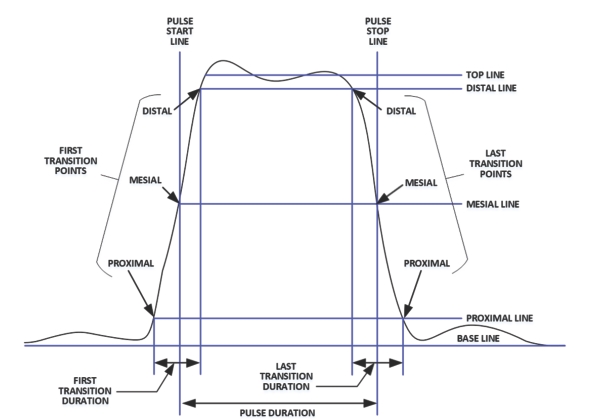
IEEE Standard Pulse Terms and Definitions “provides fundamental definitions for general use in time domain pulse technology.” Several key terms defined in the standard are reproduced in this subsection, which also defines the terms appearing in the ML2439A text mode display of automatic measurement results.
Standard IEEE Pulse
The key terms defined by the IEEE standard are abstracted and summarized below. These terms are referenced to the standard pulse illustrated in Figure: IEEE Standard Pulse.
IEEE Standard Pulse
Pulse Definitions
Base Line
The two portions of a pulse waveform which represent the first nominal state from which a pulse departs and to which it ultimately returns.
Top Line
The portion of a pulse waveform which represents the second nominal state of a pulse.
First Transition
The major transition of a pulse waveform between the base line and the top line (commonly called the rising edge).
Last Transition
The major transition of a pulse waveform between the top of the pulse and the base line (commonly called the falling edge).
Proximal Line
A magnitude reference line located near the base of a pulse at a specified percentage (normally 10%) of pulse magnitude.
Distal Line
A magnitude reference line located near the top of a pulse at a specified percentage (normally 90%) of pulse magnitude.
Mesial Line
A magnitude reference line located in the middle of a pulse at a specified percentage (normally 50%) of pulse magnitude.